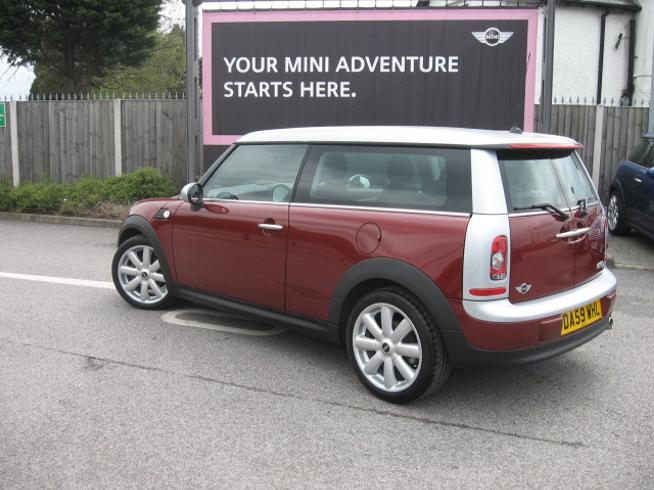
Mini Cooper Classic Cars - Morris Mini K

Morris Mini K (March 1969 – August 1971, Australia only)


The Mini is a small car that was made by the British Motor Corporation (BMC) and its successors from 1959 until 2000. The original is considered a British icon of the 1960s, and its space-saving front-wheel-drive layout (that allowed 80% of the area of the car's floorpan to be used for passengers and luggage) influenced a generation of car-makers. The vehicle is in some ways considered the British equivalent to its German contemporary, the Volkswagen Beetle, which enjoyed similar popularity in North America. In 1999 the Mini was voted the second most influential car of the 20th Century, behind the Ford Model T.

Mini Cooper Classic Cars


Built in the Australian British Motor Corporation factory at Zetland, NSW using 80% local content, the Morris Mini K was advertised as the "great leap forward". The Mini K ('K' standing for Kangaroo) had a 1098 cc engine and was the last round-nose model to be produced in Australia, originally priced at $1780 (AUD).


Read more »

Mini Pick-up Platform Car (1961–1982)

Mini Pick-up (1961–1982)


Mini Classic CarsPicture Of Mini Classic Cars

A pick-up truck, 11 ft (3.4 m) from nose to tail, built on the longer Mini Van platform, with an open-top rear cargo area and a tailgate. The factory specified the weight of the Pickup as less than 1,500 lb (680 kg) with a full 6 imperial gallons (27 L; 7 US gal) of fuel.


Mini Classic Cars

Picture Of Mini Classic Cars

As with the Van, the Pickup did not have a costly chrome grille. Instead, a simple set of stamped metal slots allowed airflow into the engine compartment. The Pickup was spartan in basic form, although the factory brochure informed prospective buyers that "[a] fully equipped Mini Pick-up is also available which includes a recirculatory heater." Passenger-side sun visor, seat belts, laminated windscreen, tilt tubes and cover were available at extra cost. Like the van, the Pickup was renamed as the Mini 95 in 1978.

A total of 58,179 Mini Pickups were built.

Read more »

Mini Classic Cars - Mini Moke (1964–1989)

Mini Classic Cars - Mini Moke (1964–1989)

Mini Classic Cars Picture Of Mini Classic Cars

A utility vehicle intended for the British Army, for whom a few twin-engined 4-wheel-drive versions were also built. Although the 4WD Moke could climb a 1:2 gradient, it lacked enough ground clearance for military use. The single-engined front-wheel-drive Moke enjoyed some popularity in civilian production. About 50,000 were made in total, from 1964 to 1968 in the UK, 1966 to 1982 in Australia and 1983 to 1989 in Portugal. The car featured in the cult 1967 TV series The Prisoner, and is popular in holiday locations such as Barbados and Macau, where Mokes were used as police cars. Mokes were also available to rent there as recently as March 2006. "Moke" is archaic British slang for a donkey.
Read more »

Mini Classic Cars - Mini Van (1960–1982)

Mini Classic Cars - Mini Van (1960–1982)

Mini Classic Cars

A commercial panel van rated at ¼-ton load capacity. Built on the longer Traveller chassis but without side windows, it proved popular in 1960s Britain as a cheaper alternative to the car. it was classed as a commercial vehicle and as such carried no sales tax. A set of simple stamped steel slots served in place of a more costly chrome grille. The Mini Van was renamed as the Mini 95 in 1978, the number representing the gross vehicle weight of 0.95 tons. 521,494 were built. Despite this renaming, the motoring public continued to call it the Mini Van, as a result of which the class of vehicles known as minivans in other countries are referred to in Britain as MPVs.
Read more »

Mini Classic Cars - Morris Mini Traveller and Austin Mini Countryman (1961–1969)

Mini Classic Cars - Morris Mini Traveller and Austin Mini Countryman (1961–1969)

Mini Classic CarsPicture Of Mini Classic Cars

Two-door estate cars with double "barn"-style rear doors. Both were built on a slightly longer chassis of 84 inch (2.14 m) compared to 80.25 inch (2.04 m) for the saloon.

Mini Classic CarsPicture Of Mini Classic Cars

The luxury models had decorative, non-structural wood inserts in the rear body which gave the car a similar appearance to the larger Morris Minor estate which had some of the look of an American-style 1950s Woodie. Approximately 108,000 Austin Mini Countrymen and 99,000 Morris Mini Travellers were built.
Read more »

Mini Classic Cars - Wolseley Hornet and Riley Elf (1961–1969)

Mini Classic Cars - Wolseley Hornet and Riley Elf (1961–1969)

Mini Classic CarsPicture Of Mini Classic Cars

Built as more luxurious versions of the Mini, both the Wolseley Hornet and the Riley Elf had longer, slightly finned rear wings and larger boots that gave the cars a more traditional "three-box" look. Front-end treatment, which incorporated each marque's traditional upright grille design, also contributed to a less utilitarian appearance. The cars had larger-diameter chrome hubcaps than the Austin and Morris Minis, and additional chrome accents, bumper overriders and wood-veneer dashboards. The Riley was the more expensive of the two cars. The name "Wolseley Hornet" was first used on a 1930s sports car, while the name "Elf" recalled the Riley Sprite and Imp sports cars, also of the 1930s. The full-width dashboard was a differentiator between the Elf and Hornet. This better dashboard was the idea of Christopher Milner the Sales Manager for Riley.

Mini Classic CarsPicture Of Mini Classic Cars

Both cars went through three versions. Initially, they used the 848 cc engine, changing to a single carburettor version of the Cooper's 998 cc power unit in the Mark II in 1963. The MKIII facelift of 1966 brought wind-up windows and fresh-air fascia vents; also concealed door hinges two years before these were seen on the mainstream Mini. 30,912 Riley Elfs and 28,455 Wolseley Hornets were built.
Read more »