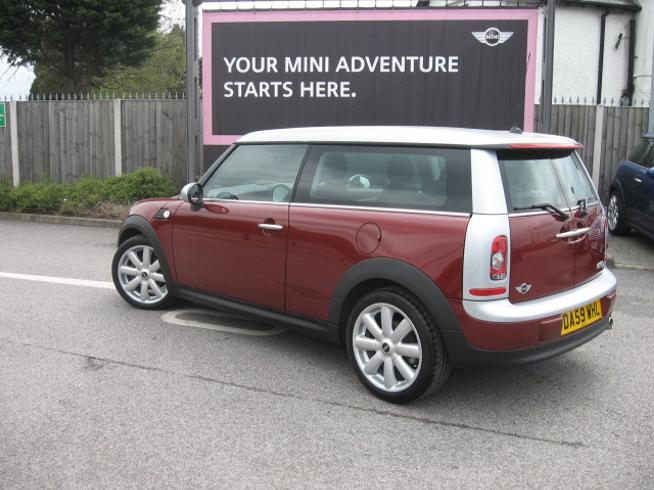
Mini Classic Cars - Mini Van (1960–1982)

Mini Classic Cars - Mini Van (1960–1982)

Mini Classic Cars

A commercial panel van rated at ¼-ton load capacity. Built on the longer Traveller chassis but without side windows, it proved popular in 1960s Britain as a cheaper alternative to the car. it was classed as a commercial vehicle and as such carried no sales tax. A set of simple stamped steel slots served in place of a more costly chrome grille. The Mini Van was renamed as the Mini 95 in 1978, the number representing the gross vehicle weight of 0.95 tons. 521,494 were built. Despite this renaming, the motoring public continued to call it the Mini Van, as a result of which the class of vehicles known as minivans in other countries are referred to in Britain as MPVs.
Read more »

Mini Classic Cars - Morris Mini Traveller and Austin Mini Countryman (1961–1969)

Mini Classic Cars - Morris Mini Traveller and Austin Mini Countryman (1961–1969)

Mini Classic CarsPicture Of Mini Classic Cars

Two-door estate cars with double "barn"-style rear doors. Both were built on a slightly longer chassis of 84 inch (2.14 m) compared to 80.25 inch (2.04 m) for the saloon.

Mini Classic CarsPicture Of Mini Classic Cars

The luxury models had decorative, non-structural wood inserts in the rear body which gave the car a similar appearance to the larger Morris Minor estate which had some of the look of an American-style 1950s Woodie. Approximately 108,000 Austin Mini Countrymen and 99,000 Morris Mini Travellers were built.
Read more »

Mini Classic Cars - Wolseley Hornet and Riley Elf (1961–1969)

Mini Classic Cars - Wolseley Hornet and Riley Elf (1961–1969)

Mini Classic CarsPicture Of Mini Classic Cars

Built as more luxurious versions of the Mini, both the Wolseley Hornet and the Riley Elf had longer, slightly finned rear wings and larger boots that gave the cars a more traditional "three-box" look. Front-end treatment, which incorporated each marque's traditional upright grille design, also contributed to a less utilitarian appearance. The cars had larger-diameter chrome hubcaps than the Austin and Morris Minis, and additional chrome accents, bumper overriders and wood-veneer dashboards. The Riley was the more expensive of the two cars. The name "Wolseley Hornet" was first used on a 1930s sports car, while the name "Elf" recalled the Riley Sprite and Imp sports cars, also of the 1930s. The full-width dashboard was a differentiator between the Elf and Hornet. This better dashboard was the idea of Christopher Milner the Sales Manager for Riley.

Mini Classic CarsPicture Of Mini Classic Cars

Both cars went through three versions. Initially, they used the 848 cc engine, changing to a single carburettor version of the Cooper's 998 cc power unit in the Mark II in 1963. The MKIII facelift of 1966 brought wind-up windows and fresh-air fascia vents; also concealed door hinges two years before these were seen on the mainstream Mini. 30,912 Riley Elfs and 28,455 Wolseley Hornets were built.
Read more »

Mini Classic Cars - Mark II Mini (1967–1973)

Mini Classic Cars - Mark II Mini (1967–1973)

Mini Classic CarsPicture Of Mini Classic Cars

The Mark II Mini Classic Cars featured a redesigned grille which remained with the car from that point on. Also, a larger rear window and numerous cosmetic changes were introduced. 429,000 Mark II Minis were made.

Mini Classic CarsPicture Of Mini Classic Cars

A bewildering variety of Mini types were made in Pamplona, Spain, by the Authi company from 1968 onwards, mostly under the Morris name.

Mini Classic CarsPicture Of Mini Classic Cars

The Mini was arguably the star of the 1969 film The Italian Job, which features a car chase in which a gang of thieves drive three Minis down staircases, through storm drains, over buildings and finally into the back of a moving bus. This film was remade in 2003 using the new MINI.
Read more »

Mini Classic Cars - Mark I Mini (1959–1967) The End Part

Mini Classic Cars - Mark I Mini (1959–1967) The End Part

Mini Classic Cars Picture Of Mini Classic Cars

From October 1965 the option of an Automotive Products (AP) designed four-speed automatic transmission became available. Cars fitted with this became the Mini-Matic

Mini Classic Cars Picture Of Mini Classic Cars

Slow at the outset, Mark I sales strengthened across most of the model lines in the 1960s, and production totalled 1,190,000. Sold at almost below cost, the basic Mini made very little money for its owners. However, it still did make a small profit. Ford once took a Mini away and completely dismantled it, possibly to see if they could offer an alternative. It was their opinion though, that they could not sell it at BMC's price. Ford determined that the BMC must have been losing around 30 pounds per car. BMC insisted that the way company overheads were shared out, the Mini always made money. Larger profits came from the popular De Luxe models and from optional extras such as seat belts, door mirrors, a heater and a radio, which would be considered necessities on modern cars, as well as the various "Cooper" and "Cooper S" models, to be discussed later.


Mini Classic Cars Picture Of Mini Classic Cars

The Mini etched its place into popular culture in the 1960s with well-publicised purchases by film and music stars.
Read more »

Mini Classic Cars - Mark I Mini (1959–1967) Part 2

Mini Classic Cars - Mark I Mini (1959–1967) Part 2

Mini Classic CarsPicture Of Mini Classic Cars

Until 1962, the cars appeared as the Austin 850 and Morris 850 in North America and France, and in Denmark as the Austin Partner (until 1964) and Morris Mascot (until 1981). The name Mini was first used domestically by BMC for Austin's version in 1961, when the Austin Seven was rebranded as the Austin Mini, somewhat to the surprise of the Sharps Commercials car company (later known as Bond Cars Ltd) who had been using the name Minicar for their three-wheeled vehicles since 1949. However, legal action was somehow averted, and BMC used the name Mini thereafter.

Mini Classic CarsPicture Of Mini Classic Cars

In 1964, the suspension of the cars was replaced by another Moulton design, the hydrolastic system. The new suspension gave a softer ride but it also increased weight and production cost and, in the minds of many enthusiasts, spoiled the handling characteristics for which the Mini was so famous. In 1971, the original rubber suspension reappeared and was retained for the remaining life of the Mini.
Read more »